

by Faye Henry-David
“Reading is an active, imaginative act; it takes work.” – Khaled Hosseini
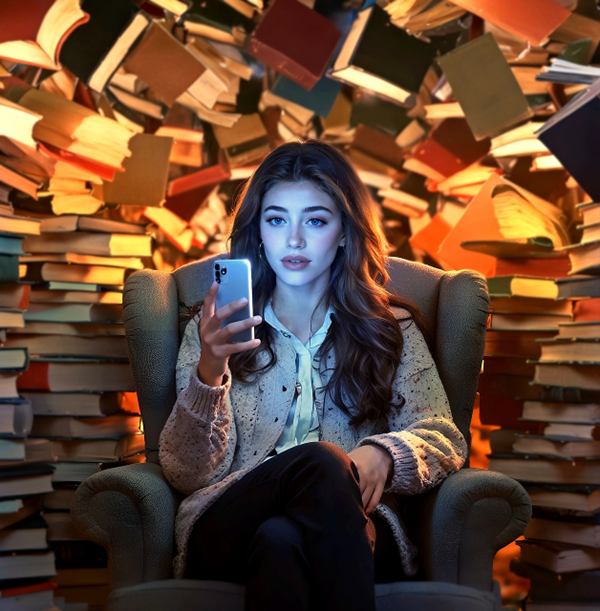
Can you remember the last time that you held a book in your hand and read without it being school or work related? Hmm….

Technology has drastically changed the way that we read. The relationship between technology and reading has impacted reading habits since there are many devices and platforms that are easily accessible for readers (Technology.org, 2023).
Here are a few ways technology has changed reading:
- Portable – We can access our favourite books on a tablet, smartphone or other reading platforms from anywhere. These devices tend to be smaller and lighter so it may be easier to carry around than a physical book. We can even play games, do online shopping and other activities without leaving home (Technology.org, 2023).
- Interactive – Technology has provided a variety of ways to interact with the text. We can change settings such as font sizes and background colours to read better. Some platforms allow you to make notes, search a dictionary and engage you with other activities as you read (Technology.org, 2023).
- Resourceful – There are many varieties of digital tools and resources to improve reading or other areas of learning. Individuals who are struggling with reading can be taught using reading programs. Additionally, there is access to numerous content from around that can be acquired to make learning enjoyable both in and out of the classroom.
- Cost-friendly – Reading material can be downloaded for free (Thombson, 2022).
But should it be the only way to read?
There is still value in getting in some Page Time.
Books help to control the information being sought. Although it may be limited at times, it gives you the direct information needed. Whereas with a Google search, a wide array of information would be available but sometimes it is like trying “to find a needle in a haystack” (Schwartz, 2023). This can be time consuming.
With books, there are no distractions. There are no Ads popping up or social media notifications. Therefore, you are better able to concentrate on reading.
Engaging with books has proven to improve comprehension and help you remember what you are learning better. Research has shown that comprehension suffers when you read from a screen (Schwartz, 2023).
They are also portable. They also do require charging or access to the internet to function. Making them great for places with limited internet capability.
When one reads books first, they are better able to transfer these skills when reading from a screen (Korbey, 2023).
So cubs, what do you think?🤔
Do you prefer Screen Time or Page Time?
What do you believe reading will be like in ten years?
Will “it be necessary” for individuals to be able to read? 😁
Share your thoughts with us in the comments below.
5 responses to “Reading Reimagined”
References
Estelle, I. (2024, May 23). Reading benefits: Books vs digital.
https://medium.com/@ilana_73874/reading-benefits-books-vs-digital-3a707a7db100
Korbey, A. (2023, April 19). Books vs. Screens: What Does the Latest Research Say?
https://www.govtech.com/education/k-12/books-vs-screens-what-does-the-latest-research-
say
Schwartz, S. (2023, March 15). Kids understand more from books than screens, but that’s not always the case. Education Week. https://www.edweek.org/teaching-learning/kids-
understand-more-from-books-than-screens-but-thats-not-always-the-case/2023/03
Technology.org. (2023, November 22). The impact on technology on reading habits and the future of
reading. https://www.technology.org/2023/11/22/the-impact-of-technology-on-reading-habits-
and-the-future-of-reading/
Thombson, J. (2022, October 27). Six benefits of online books over printed books.
https://www.academicgates.com/blog/six-benefits-of-online-books-over-printed-books/454
Discover more from ROAR
Subscribe to get the latest posts sent to your email.

Leave a Reply